
Why Are Cats Afraid of Cucumbers? The Real Reason (and Why You Shouldn't Try It)
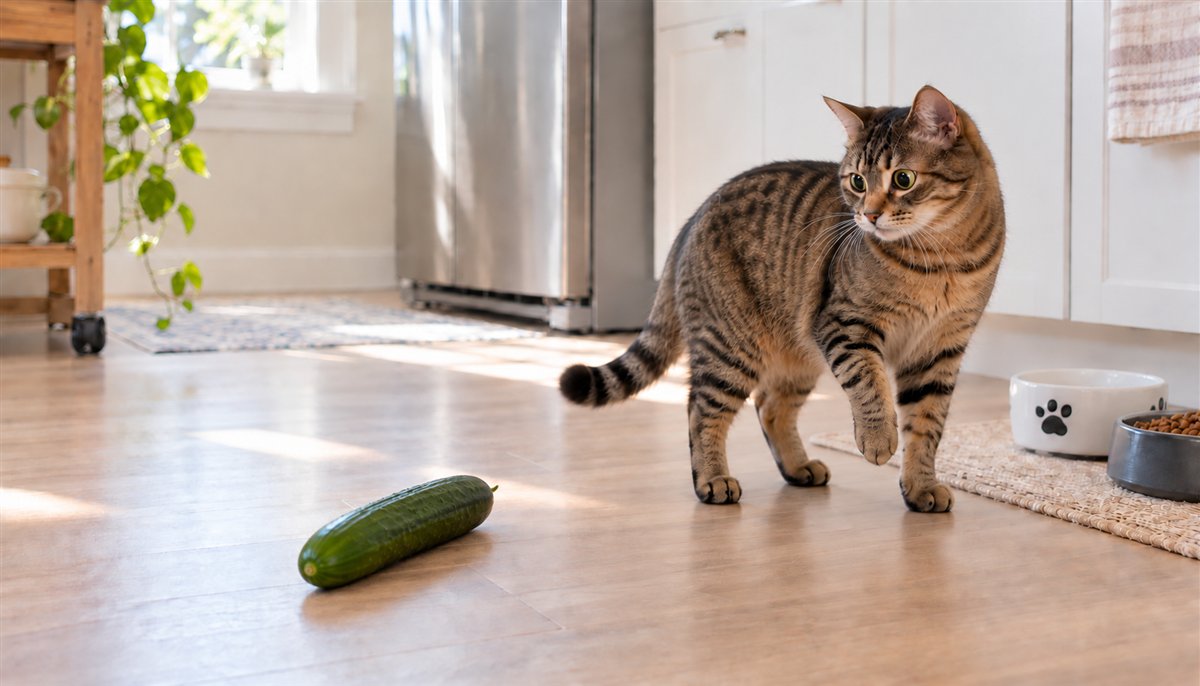
You've seen the videos: a cat is happily eating, someone silently places a cucumber behind it, and when the cat turns around it launches itself three feet into the air like it's been electrified. Millions of views, endless remixes. But here's what the videos don't tell you — the fear has almost nothing to do with cucumbers, and animal behaviorists really wish people would stop trying it at home. Drawing on veterinary sources and feline behavior researchers, here's what's actually happening in that split second — and why the joke costs your cat more than it's worth.
It's not the cucumber. It's the surprise.
Cats are a fascinating evolutionary contradiction: they're predators, but they're small enough to be prey. That double life shaped a nervous system that treats sudden, unexplained changes in the environment as potential threats — and reacts first, thinks later. Behavior researchers call it the startle response: an automatic, hard-wired reflex that fires before the conscious brain has even identified what the object is.
When a cat is eating, it's at its most relaxed and least vigilant. Its head is down, its attention is on the bowl, and it has already scanned the area and filed it as secure. So when the cat lifts its head and finds that the world has changed behind its back — something is there that wasn't there seconds ago, and it never heard it arrive — its brain does the only sensible thing a small animal's brain can do: jump first, identify later.
That explosive vertical leap isn't comedy. It's a survival program that says "get out of striking range now." If the mysterious object had been a real predator, that reflex would have saved the cat's life. The fact that it's a vegetable is irrelevant to the reflex — a hairbrush, a toy truck, or a bunch of bananas placed the same way often triggers the same panic.
But doesn't the cucumber look like a snake?
This is the internet's favorite theory, and it's not entirely baseless. Some behaviorists have suggested that a cucumber's shape — long, green, curved, low to the ground — is a decent visual match for a snake, and cats share an ancient, well-documented wariness of snakes with many mammals. A snake-shaped object suddenly within striking distance would justify maximum alarm.
Other researchers are more skeptical. Their argument: the reaction happens with plenty of objects that look nothing like snakes, so the snake resemblance may amplify the panic, but the core trigger is the silent ambush itself. The most honest scientific answer is that both things are probably true at once:
🐍 The snake hypothesis
The shape may tap into an instinctive "snake!" alarm that evolution installed long before house cats existed. It would explain why cucumber reactions often look more dramatic than reactions to other objects.
⚡ The startle hypothesis
Any novel object appearing silently in a trusted zone violates the cat's mental map of "safe." The nervous system treats an unexplained change behind its back as an ambush — because in the wild, it might be.
🍽️ The location factor
Nearly every viral video is filmed at the food bowl — the one place a cat lets its guard down completely. The same cucumber shown to the cat face-first, across the room, usually earns nothing more than a sniff and a shrug.
Why behaviorists say: please don't try it
We get it — the videos are funny, and your cat's reaction would probably be spectacular. But veterinary behaviorists have been unusually united on this one, and their reasons are worth taking seriously:
Injury risk: a panicked cat launches blindly and can crash into counters, stovetops, shelves, or windows, and can break a claw, sprain a limb, or knock heavy objects onto itself.
Feeding-station anxiety: cats need to feel safe where they eat. One good scare can teach a cat that the food bowl is dangerous territory, leading to stress, gulping, or avoiding meals.
Broken trust: your cat can't laugh it off. What it learns is that its home — and possibly you — are unpredictable, which in sensitive cats feeds into long-term anxiety behaviors.
Stress isn't harmless: chronic feline stress is linked to overgrooming, litter box avoidance, and even urinary problems that end in a vet visit.
In short: a five-second video isn't worth weeks of a nervous cat. If your cat has already been startled badly — by a cucumber or anything else — give it space, let it come back on its own terms, and keep the feeding area calm and consistent for a while. If your cat suddenly seems jumpy all the time, that's worth a conversation with your vet, since pain and illness can also make cats hypervigilant.
The plot twist: cats can actually eat cucumber
Here's the irony nobody mentions: the vegetable from the horror videos is completely safe for cats to eat. Plain cucumber is about 95% water, low in calories, and fine as an occasional nibble — a few small, peeled pieces are plenty. Some cats genuinely enjoy the cool crunch on a hot day. Just skip pickles entirely (the salt, vinegar, and garlic are a hard no), and introduce any new food the polite way: offered from the front, not deployed as a jump scare.
Curious what else is safe to share? Our food checker covers hundreds of foods for cats and dogs in seconds.
Fun with your cat that doesn't involve terror
If you want entertaining cat content — or just a happier cat — the trick is working with feline instincts instead of against them. A wand toy that darts and hides like prey gives your cat the thrill of the hunt with none of the panic. Puzzle feeders turn mealtime into a satisfying challenge instead of an ambush site. Even a cardboard box or a paper bag (handles removed) delivers the hiding-spot joy cats crave. You'll get better videos, too: a cat mid-pounce is far more cinematic than a cat mid-heart-attack.
Want to understand what your cat is feeling in the moment? Learning to read the ears, tail, and whiskers is the real superpower — our cat body language guide breaks it all down.
Frequently asked questions
Are all cats afraid of cucumbers?
No. Reactions vary hugely between cats, and most cats shown a cucumber openly — from the front, in plain sight — just sniff it and move on. The dramatic leaps happen when the object appears silently behind a cat in a spot it considers safe.
Is it cruel to scare a cat with a cucumber?
Behaviorists strongly advise against it. The panic can cause real injuries, teach your cat that its feeding area is unsafe, and chip away at its trust in you. It's a high price for a short laugh.
My cat got scared badly — what should I do?
Stay calm and don't chase or grab your cat. Let it retreat and decompress, then rebuild good associations: quiet meals, gentle play, treats offered without surprises. If jumpiness persists for days or your cat avoids its bowl or litter box, check with your vet.
Can cats eat cucumber, then?
Yes — plain, washed cucumber in small amounts is safe for cats. Skip pickles and seasoned cucumber salads entirely. See our full cats & cucumber guide for portions and cautions.
Sources: guidance from veterinary behavior specialists, the ASPCA, and feline behavior researchers. For information only — not veterinary advice. If your cat shows ongoing anxiety or behavior changes, talk to your veterinarian.